- ieadvocates Newsletter
- Posts
- Not All Home Care Agencies Are Created Equal
Not All Home Care Agencies Are Created Equal
The right home care agency can be a vital resource to a working caregiver

ieadvocates
January 27, 2026

Working Caregivers-The Invisible Employees Newsletter
Brought to you by ieAdvocates (invisible employee advocates)

Thank you for being here!
For millions of working caregivers, the day doesn’t end when the workday does—it simply shifts into a second shift at home. According to the recent Caregiving in the US 2025 by NAC and AARP, nearly 1 in 4 Americans is providing unpaid care to an adult loved one, and 70% of them are juggling that responsibility alongside a job. When care needs increase, a working caregiver will need more support and resources. A resource that can be the difference between constant crisis management and a sustainable routine is a trusted home care agency The right agency doesn’t just send an aide; it becomes an extension of the family—supporting medication reminders, personal care, safety, companionship, and even giving the working caregiver the ability to focus at work without the constant fear of “what’s happening at home?”
But here’s the reality: not all home care agencies are created equal. Choosing the wrong one can add more stress instead of relieving it—missed shifts, poor communication, lack of proper training, or inconsistent caregivers can leave families scrambling. For working caregivers, reliability and transparency aren’t luxuries—they’re necessities. In this issue, we’ll explore why home care agencies are such a vital lifeline for employed family caregivers and, just as importantly, what questions to ask to ensure you select an agency that truly supports both your loved one and your career.
Table of Contents
In the news:

Latest research, events, and articles that are making an impact for working caregivers and their employers.
Home Care Industry Statistics : Home care surges amid aging demand, caregiver shortages, costs, innovation.
It is important to stay on top of the latest trends for this industry which is a vital resource for caregivers that will need help in caring for a family loved in especially with demand increasing and staffing shortages occurring. This reports covers the latest metrics:
Some highlights:
The median caregiver turnover rate in the home care industry was 77.1% in 2022
Nearly 90% of home care workers are women
77% of adults age 50 and older want to remain in their homes for the long term
About 70% of people over age 65 will need some form of long-term care services during their lifetime
85% of home health patients have 3 or more chronic conditions
The national median monthly cost for home health aide services (44 hours/week) was $6,292 in 2023
Families Prefer In-Home Care To Senior Living – Yet Struggle To Identify Needed Support
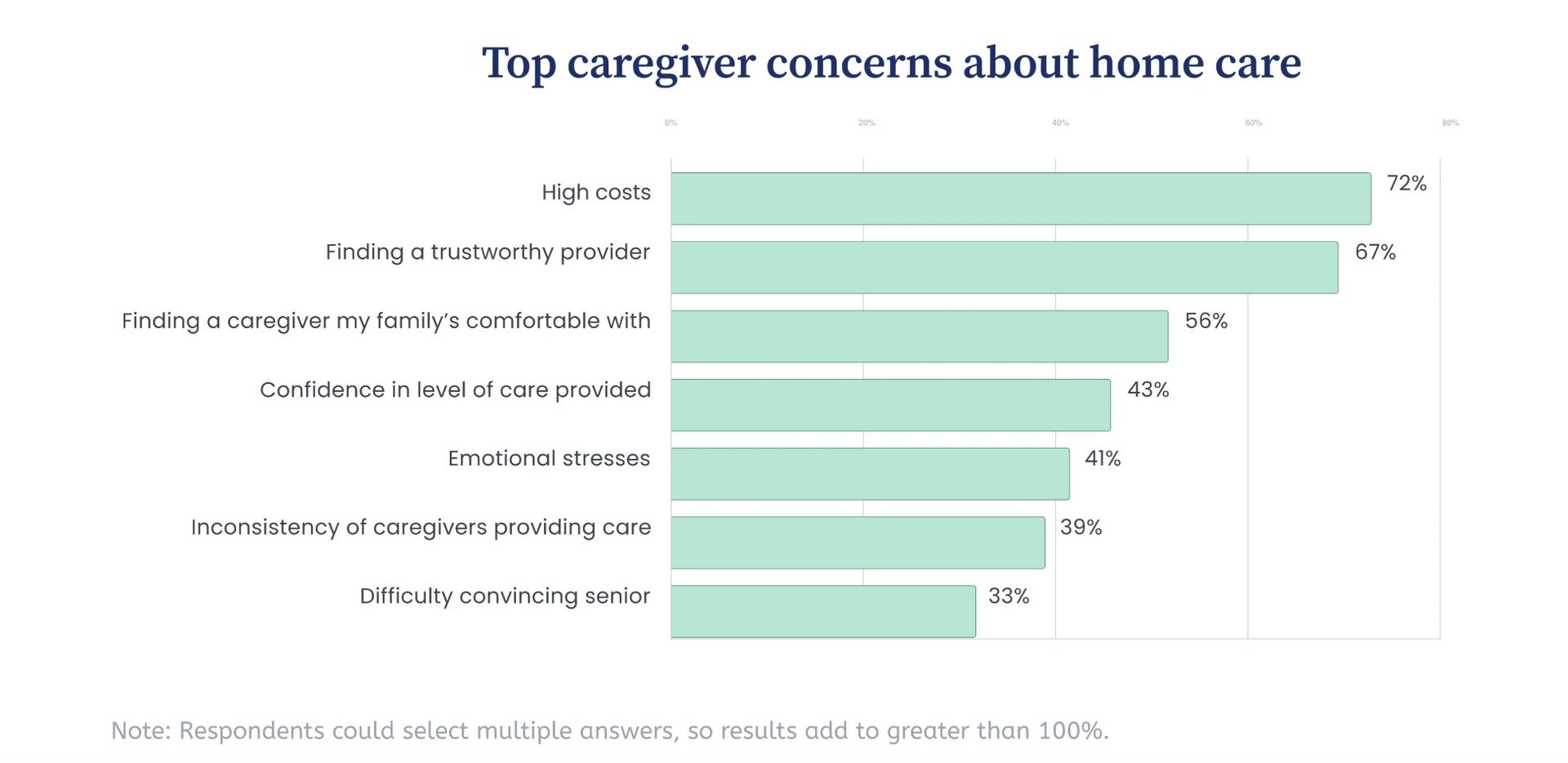
A report that summarized a survey of 1,104 family caregivers from A Place for Mom and New York City-based digital mental health company Talkspace Inc, found that most families prioritize their loved one’s comfort with a caregiver above all else – and that cost is a top concern. 84% said they valued their loved one’s independence, and 53% expressed a strong preference for in-home care over senior living. But more than one-third find it difficult to know what level of care is best for their loved one, and 41% aren’t sure what they’re looking for in a senior care experience.
Did you know? (Read our blog):

Our blog brings you knowledge, personal and researched, to raise your awareness and empathy about working caregivers and caregiving.
How to Choose a Home Care Agency Without Adding More Stress to the Caregiver by Zack Demopoulos

Phyllis Demopoulos, owner at the time, is training her home care agency’s home health aides (professional caregivers) during one of the frequently scheduled trainings as required by the state of New Jersey (2019)
In December of 2006, I was already stressed out. I was in the biggest job of my career as an HR executive, supporting a completely new and different client group, and the learning curve was steep. Working long hours, commuting almost two hours a day to and from work, and having many openings on my team, I was stressed out. Then I received the phone call…..
The Situation
…my father had a stroke, and I had to jump on a plane immediately to support my mother caring for him. Not knowing anything about caregiving, I was struggling to figure out a way to get my father back home safely. I knew nothing would be the same—his speech and his ability to stand and walk independently had been severely impaired.
Never having used EAP, I contacted the only resource I could think of and desperately asked them for any kind of help they could provide. All they gave me was a list of home care agencies in alphabetical order that I could call in my parents’ city. I had no idea what a home care agency was, what to ask them, or why I needed them! Long story short, I picked the first one on the list, they took my credit card, and charged me for two weeks, non-fundable. My mother fired them after their second visit. My mother went on to care for my father by herself with little to no help, and this impacted her physically and emotionally. This really stressed me out more.
People and Companies In the spotlight:

Our podcast puts a spotlight on guests who are making a significant difference in the working caregiver space.
Episode 33: What Every Working Caregiver Needs to Know About Home Care with Scott Greenberg

In this episode of Working Caregivers: The Invisible Employees, we sit down with longtime industry expert and caregiver Scott Greenberg for one of the most honest conversations we’ve had about what caregiving really looks like—especially while working. Scott brings decades of experience in home care, but more importantly, he shares what changed when he unexpectedly became a family caregiver himself. This is a grounded, real-world discussion about independence, denial, emotional toll, and the realities families face when care needs show up fast.
We talk openly about affordability, long-distance caregiving, sibling dynamics, and why being proactive—not reactive—can make all the difference. Whether you’re a working caregiver, an employer, or someone who knows this journey is coming, this episode is packed with insight, hard truths, and practical guidance you don’t want to miss.
Scott Greenberg is CEO of ComForcare Senior Services, a private-duty, non-medical home healthcare agency serving Miami through Vero Beach. He is Past President of the Florida State Guardianship Association and former Treasurer of the National Guardianship Association, and serves on the Board of Directors for the Area Agency on Aging. Scott is an award-winning author of Oh My God, I’m Getting Older and So Is My Mom, former host of the 95.9FM True Oldies radio show of the same name, and a nationally certified Alzheimer’s educator since 2014.

Meet Randi Ervin, a real working caregiver:

Randi Ervin
So I'm going to say care needs coordination is huge…don't undervalue that and own that you're doing a lot. So that's huge coordination. Caregivers, you're constant. So I think that's something as a care recipient I did not realize. You're there all the time… It's constant, but you guys are going to need care too, because it's not going to stop. You're going to be a caregiver. Great advice for the duration of my life and probably beyond that, because people know that you have the tendency to do that. And then with my mom, caregiving was harder than being the care recipient. I think caregiving is probably the hardest thing I'll ever do in my life, because… as the care recipient, I have come to peace with the outcome, right?...”
Randi Ervin is a pancreatic cancer survivor, family caregiver, and advocate based in Oakland, CA. Her mother, Willie Bunting Ervin, was her first caregiver during her own cancer recovery. Years later, Randi—alongside her father, her sister, and her aunts—became a caregiver for her mom during her battle with pancreatic cancer. Experiencing caregiving from both sides shaped Randi’s belief that care is not linear, caregivers are the constant, and systems must do more to support the families coordinating care every day. Connect with Randi on LinkedIn.
“ I went down to HR, and they scheduled two-hour-long meetings where I got to understand what disability looked like, what medical leave looked like. And they were frank and honest about the law, which I don't think is something a lot of people can handle. I live in California… that becomes very important, right? We've got pretty good employee rights here. So that might not be the case. So, knowing your rights, or offering like EAP or some third-party assistance, so that people can understand what rights they have.
And also for HR, and this is also for people's direct bosses, and [those] in the chain of supervision, there's the acute moment of care, right? When you know, there's the discharge or when they're out of the hospital, but then there's all the steps leading up to it. And then there's the continuous maintenance and surveillance that I think we forget about in the healthcare system, right? They think it's like two months of intensity. And then, we just forget. And so I think there's a point in which you have to see the full journey. Caregiving takes a village. It's also constant, right?”
Recommended media content:

We explore and share with you diverse media illuminating the dynamics and narratives within the care economy - from insightful podcasts to thought-provoking books and engaging videos.
PODCASTS
Raising ‘Rents (as in paRents) Podcast Host Zack Demopoulos produced a five part series on Hiring a caregiver to help you care for your family loved one and a two part series on Home Care:
Day 17: Home Care Part 1: How to a professional caregiver. Specifically how to choose a home care agency, what to look out for, what to ask, and how to protect your family.
Day 17: Home Care Part 2: Questions you should ask a home care agency before you hire them.
Episodes 29 - 33: Hiring a caregiver to help you care for your family loved one; Zack interviews five different ComForCare Home Care agency owners
BOOKS

Oh My God, I’m Getting Older and So Is My Mom by Scott Greenberg provides a roadmap to the aging highway with tips on how to avoid the potholes along the way. Through Scott Greenberg’s experience as a weekly radio show host dealing with issues that are confronting boomers and their parents, coupled with his tenure as President of a private duty home health care agency, Scott addresses many serious topics in a humorous but informative way.
VIDEOS:

Feeling overwhelmed by in-home care options? You're not alone! In this video, Coach Michele of Home Care Coaching will break down the difference between home care and home health care, so you can make the best choice for your entrepreneurial journey. Your clients may want to stay independent at home, but they need a little extra help. Is home care or home health care the right fit?

We want to thank Joseph Stepke who took the time to read our book and provide a thoughtful ⭐⭐⭐⭐⭐review!
“Working Caregivers: The Invisible Employees" is a book of immense significance that brings to light the often-underappreciated perspective of caregivers. As a person that has seen some of my own elders being aided by caregivers, I am acutely aware of the vital role the caregiver plays in the lives of those they care for, and I am deeply grateful for their selfless dedication.
This book beautifully captures the impact of caregiving on their lives, and I commend the authors for their outstanding work. It serves as a crucial resource for employers looking to understand the caregiver experience better, shedding light on the challenges they face while offering valuable insights on how companies can provide support.
Zack and Selma's dedication to being a resource for caregivers, employers, and families shines through in this exceptional book. "Working Caregivers: The Invisible Employees" strikes a perfect balance between storytelling and informative content, making it an essential read for anyone seeking a deeper understanding of the caregiving journey and how to support caregivers effectively..”

Order your copy of Working Caregivers-The Invisible Employees book here. If you want to order a quantity of books for your leadership team and employees, contact us directly about discount pricing.

If someone forwarded you this newsletter, then you can subscribe below: